

Welcome! (B’rukhim HaBa’im)
Welcome to our assembly, and Shabbat Shalom [Sabbath Peace]! We hope you do decide to visit us! As we strive to love one another and to emulate Yeshua, just like The Word compels us to! [1 Cor 11:1] Dress is ‘business casual’ or better, with modesty.
What to expect:
Mikdash Meh’at is a Synagogue, so we do the ancient biblical prayers , as Yeshua would have done in Nazareth in His Synagogue [Luke 4:16]. We pray them in Hebrew first, and then English. The main reason we pray in Hebrew is because it is the most perfect form of the written Word; it is not tainted by man in translation. We are praying scripture exclusively.

There are six sets of prayers. We cycle through different ones in each section of our Siddur [prayer book] each week. Siddur is ‘order’ of service. You will be provided a guest copy of the Siddur, so please come!
These are the six sections of prayers:
“K’doshim” is ‘sanctification’ of our hearts and our service to Him, seeking forgiveness.
“Shakhan” is ‘glory/dwelling’, where we invoke His Presence.
Weekly Psalm: This includes one Psalm that goes with our reading portion.
“Shmonei Esrei” is the 18 ancient benedictions [we will choose one],
“B’rakha Al Yisra’el” is a blessing over our Jewish people,
“B’rakha Al Meshi’akhim” is a blessing over the Body of Messiah”.
Everything we pray in Hebrew, we will also pray in English. The Siddur has notes in the front on how our transliterations work, when you decide to pray with us in Hebrew. We have a glossary on our website and in our liturgy, and a mini glossary is provided to visitors of the words you will see in the Siddur.
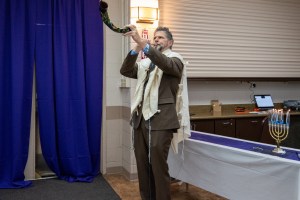
We begin our services with the blast of the Shofar [ram’s horn trumpet]. This calls us to order. Then, we begin prayer by praying Psalm 100, the prayer that was said daily in the Temple. It is a convocation to worship. Then, we sing songs of worship. They are in Hebrew and/or English, but all are either directly quoting scripture, or paraphrasing scriptural passages of worship.
We then continue to worship in prayer, with a call to prayer, to begin the six sections of prayer already mentioned. This is completed with a “Torah Service”, where we bring the Torah Scroll out and carry it through the Congregation. This is an ancient ceremony that our Jewish forebears observed, and we can ‘see’ Yeshua walking through the land of Israel and blessing the people. It is then opened and laid down for reading. We bless our children before reading, in the way commanded by Israel just before he died. Yeshua was ‘opened’ and laid down in death, to give us life. So we open and lay down the scroll for reading. Then, we have a ‘Drash’, the ‘seeking out’ of what God would instruct this congregation about for the week, according to a “Parashah”, the ‘portions’ read from each section of Scripture: The Torah, The Prophets, and the “Brit Khadashah”, or ‘Renewed Covenant’ scriptures. After, we then raise the Torah [resurrection] and return it to the Ark [Heaven/The Father’s heart], and bless the congregation.

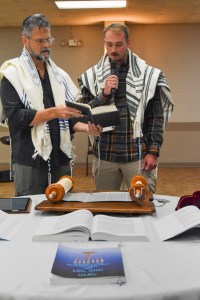
All of this is a picture of Yeshua’s ministry up to this point: coming from God through miracle birth, declaring the gospel and blessing the people, dying for our sakes, rising, and returning to Heaven to sit at God’s right hand.
“Religion” is for our children [Exodus 12:26 Deut 6:7]. The rites of ‘religion’ embed The Word in them through all the senses. This is a part of that, and helps to teach all of us as well.
Mikdash Meh’at founded and is part of the “Messianic Peshitta Fellowship”. Peshitta means ‘plain interpretation’. It is an Aramaic word. The ancient Aramean believers in the near east rejected Constantine based on plain interpretation of the Scriptures. We believe the letters were originally written in Aramaic, and that the Greek and Aramaic texts prove this. [Nearly 20 years of studying the Aramaic Peshitta texts keeps confirming this]. As such, we read from “The Word“, a translation derived from the Masoretic Hebrew and the Aramaic Peshitta texts, and two very sound English translations of each. We do not think the Greek is ‘bad’, only slightly faulty and confusing on some very key issues. Thus, you will still see intimate familiarity in our Scripture Readings.
We transliterate very important words. The reason for this is two-fold: 1) to insist that there is not a single, English word that sufficiently translates the Hebrew concept of those transliterated words, and/or that the traditional rendering is faulty. Example: חן and חסד . The first word is khen, or ‘grace’, and the second is ‘khesed’ or ‘compassion.’ Greek translators dismissed ‘חסד’ and almost used ‘חן’ exclusively. We think this is a disservice to the reader. 2) to use as a teaching tool. Many of us are studying Hebrew; some are pursuing fluency, some just studying enough to better understand prayer service. Thus, the transliterations help immensely. We hope this is not too off-putting: we are making a more friendly, English rendering of all our texts, however. Please just bear with us. Look at the glossary if you are unfamiliar with the terms you will hear today. Also, everything we say in Hebrew/transliteration, we also say in English.
We believe plain interpretation of scripture is critical. Going deeper without foundation is folly.
We say the Name of God: יהוה . We have studied the language, the culture, the scriptures, and antiquity, and believe we have arrived at the best pronunciation of His Name. We do not disparage those who disagree, but many of them disparage us.
God tells us to declare His Name in the Congregations, and among the Gentiles. His Name is an Everlasting, Spoken Memorial of His infinite nature. We will not conceal it, blot it out by exchange, nor cow to any religious group to placate them over their manmade doctrine.
יהוה
Yeshua’s Name is preserved in the Bible in Hebrew and Aramaic. It is thus pronounced only as “Yeshua”. Jews in the Holy Land preserved the language as it was spoken in the Holy Land in Yeshua’s day through the system of “nikodot”, known as ‘diacritical markings’. Aramaic ‘vowels’ are intrinsict to Aramaic texts. Together, the Masoretic and Aramaic sacred texts remove all doubt that His Name is Yeshua, ישוע . No other pronunciation is accepted here. It is not necessary to stuff the Sacred Name יהוה into ישוע, since Yeshua’s full Name is already יהוה ישוע המשיח . In English, that is יהוה Yeshua the Messiah, where many call Him “The LORD Jesus Christ”.
ישוע
Paul tells us in Phillipians 2:10-11 that Yeshua has a Name to which every knee will bow, and He tells us that it is יהוה ישוע המשיח , to the Glory of God His Father, who conferred His own Name onto the Man, Yeshua from Nazareth.
We celebrate all the Mo’adim: The “appointed times” given to us by God our Father, observed on earth by His Son, Yeshua:
אֵלֶּה הֵם מוֹעֲדָי
“These are my mo’adim”
Sabbath: The weekly appointed feast that begins at the end of the 6th day, ending at the end of 7th day. Biblical days start at sundown and end at the next sundown. So, the Sabbath is Fri night to Sat night. We meet on the Seventh Day, according to His Word, as did Yeshua [Luke 4:16] It is a ‘Mini Passover’.
Passover: The first of the seven annual feasts. This one begins in Spring, and sets the timing for all the others that follow. This one is held on the 14th evening after the first “khodesh” or ‘renewed crescent moon’. Yeshua died on the 14th day of the 1st month, after celebrating Pesakh on the right night, night 14 after the khodesh.
Unleavened Bread: We begin to eat unleavened bread for seven days on the night of the Passover. The feast of unleavened bread is thus that first night, plus six more nights [Deut 16] of “Matzot”. They made Matzot on day 14, and walked out of Egypt on Night 15, which begins “Matzot” for six more days. [Deut 16]
Firstfruits: An Omer for the Wave-sheaf offering of barley is waved in the temple on the first day of the week that comes after the Sabbath after Passover. This is always the 1st day of the week [sun], since Yeshua died on Wed evening and was in the grave for 3 days and 3 nights. He arose at the departure of the Sabbath [Sat night], and presented Himself as Firstfruits from among the dead.
Weeks: God instructed Israel to count seven sabbaths after the First Omer of firstfruits, and to hold a sacred assembly on the 50th day after the 7 sabbaths, a total of 49 days. On the 50th day, two loaves of leavened bread were waved, fuller loaves of bread. Yeshua ‘filled’ the 500 men and women on “Shavu’ot” with His Spirit, and the gospel was declared for the very first time, on the same calendar day the Torah came down off the mountain with Moses.
Rosh HaShanah: Known as “Yom Teru’ah”, the “Day of the Awakening Blast”, “The Day That No Man Knows”, and many other names; Messiah will come for His Bride, and the Tribulation will begin.
Yom Kippur: Final Judgment of the world at the end of the Tribulation, when sins are “Atoned”, or ‘covered’.
Sukkot: Tabernacles. Yeshua was born on the first day, circumcised on the eighth day of this feast. He will ‘Tabernacle” on earth for 1,000 years, the seventh millenium.
Yeshua has fulfilled the first four feasts. The last three remain. When it is time, the Shofar will sound, the dead in Messiah will rise, the Bride will be ‘caught up’ and go to the bride chamber. Seven years of Tribulation will occur, and then Yom Kippur and Sukkot will be fulfilled on earth.
Here is the mini glossary of the words you’ll hear the most in a prayer service:
יהוה : God’s infinite Name: it means, “He was, He is, He will be”. Four vowels: ee ah uu ah , forming diphthongs: Yahu’ah. The English rendering is Yahweh.
ישוע : Yeshua means “Salvation”. It is a name given among men. The best English rendering is Joshua. We only call Him Yeshua. He is “Mashi’akh”, Yeshua the Messiah.
Elohim: God, The Father.
Kadosh/Kodesh/Kadash/K’doshim: Holy, sacred, set-apart, consecrated. “Set apart for a very specific, divine purpose.” Holy Ones.
Melekh: “King” a ruler who rules with authority and in compassion.
Malkhut: “Kingdom”, realm of a king; Malkhuto is His Kingdom.
Seh: “lamb”, since Yeshua is the “Lamb of God”, “Seh HaElohim”.
Abba: “Daddy”, God our Father.
B’nei: “Sons of….” B’nei Yisra’el, Sons of Israel
Brit: “Blood Covenant”; Aron HaBrit: Ark of the Covenant.
Khadashah: “renewed”; Brit Khadashah, “Renewed Covenant”.
K’vod: “Glory”, the manifest Presence of God
Barukh: “Bless”, a call for all to worship