
 The Feasts of יהוה
There is one weekly feast, and seven yearly ‘feasts’. The weekly feast is the Sabbath, falling on the Seventh day. The yearly feasts are in two seasons: Spring and Fall. The Spring Feasts are Passover, Unleavened Bread, Firstfruits, and Weeks. The Fall Feasts are Rosh Hashanah, Yom Kippur, and Sukkot.
There are two additional, Biblical feasts, not commanded, but observed, and very prophetic: Khanukah, and Purim. These occur in the darkness of Winter.
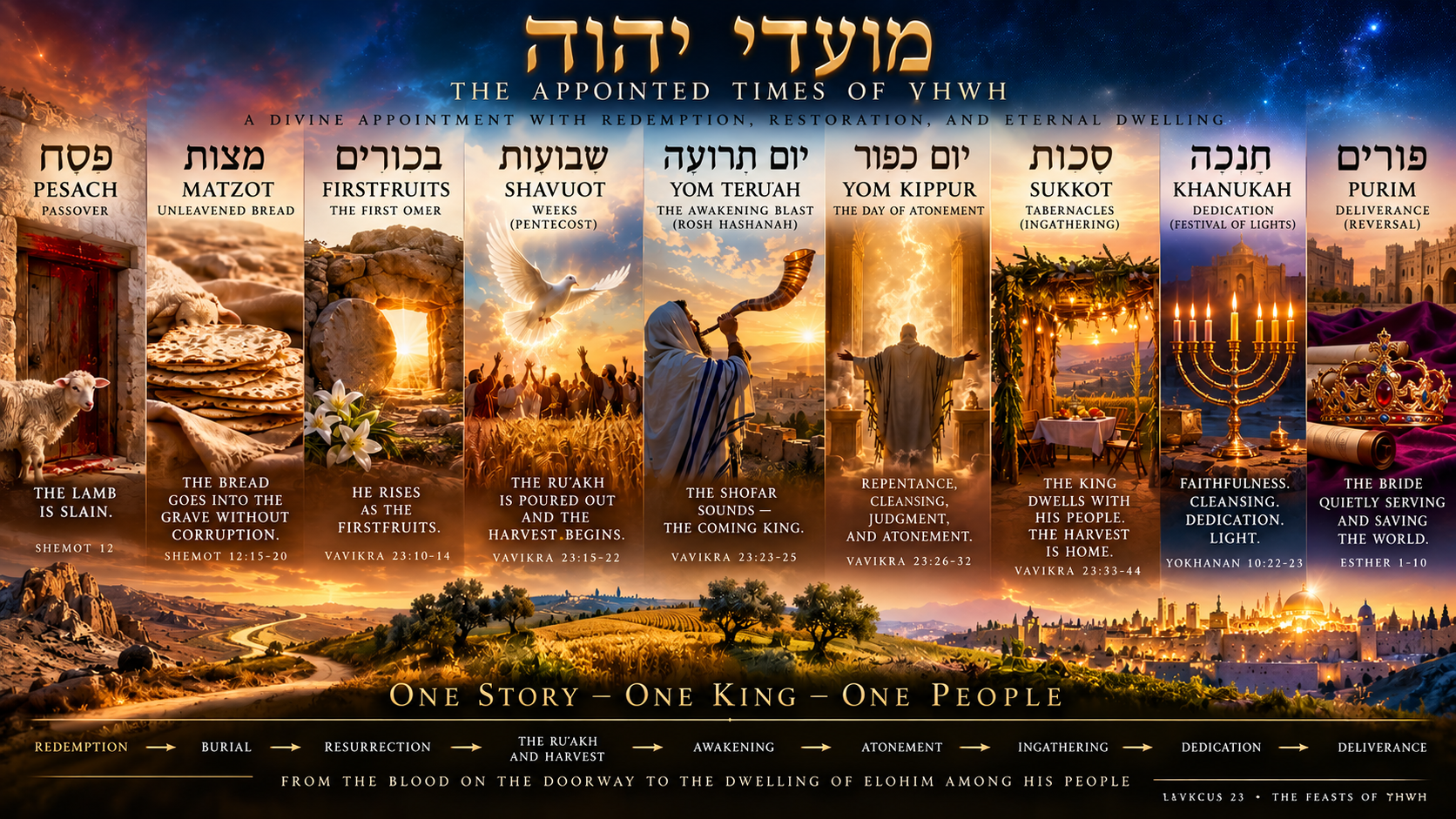
Below is a description of each, and their significance for the Messianic Believer.
What is the Sabbath:
The Sabbath—Shabbat—is quite simply the Seventh Day of the week, a day that יהוה Himself set apart from every other day. The Sabbath did not begin with Moshe. It did not begin with Judaism. It did not begin at Sinai. It began at Creation. “And on the seventh day Elohim ended His work which He had made; and He rested on the seventh day from all His work which He had made. And Elohim blessed the seventh day, and consecrated it.” B’reshit [Genesis] 2:2–3 Before there was an Israel, before there was a Jew, before there was a Sinai, there was the Seventh Day. Elohim Himself rested upon it, blessed it, and made it kadosh.
When יהוה later gave Israel His Ten Words, He did not introduce the Sabbath as something new. He said: “Remember Yom HaShabbat, to keep it kadosh.” Shemot [Exodus] 20:8 And He tells us exactly which day He means: “Six days will you labor, and do all your work; but the seventh day is a Shabbat unto יהוה your Elohim.” Shemot 20:9–10 That really is not complicated.
The Sabbath is the Seventh Day. It is a day to cease from our ordinary labor, to set aside the business of our own little kingdoms, and turn our attention toward His Kingdom. It is a day of rest, worship, Scripture, prayer, family, fellowship, mercy, and delight. Yesha-Yahu tells us: “Call Shabbat a delight, and the kadosh of יהוה honorable.” Yesha-Yahu [Isaiah] 58:13 Notice that word: delight. Shabbat was never intended to become a miserable collection of manmade restrictions. Neither do we believe that honoring Shabbat means replacing the commandments of Elohim with Rabbinic fences around them. Our standard is the Torah, interpreted for us perfectly in the life and halakha of Yeshua HaMashi’akh.
And what did Yeshua do? He kept Shabbat. He attended the Beit K’nesset on Shabbat. He taught on Shabbat. He healed on Shabbat. He permitted His hungry Talmidim to pluck grain and eat on Shabbat. When challenged by those who had burdened the day with their traditions, He reminded them of something fundamental: “Shabbat was made for man, and not man for Shabbat. Therefore Ben HaAdam is Adon even of Shabbat.” Markos [Mark] 2:27–28 He did not abolish His Father’s Sabbath. He showed us how to live it.
And after His resurrection, His Shlikhim continued to be found teaching and worshipping on Shabbat (Acts 13:14, 42–44; 16:13; 17:2; 18:4). The Sabbath therefore is not how we earn salvation. We do not obey Torah in order to persuade Elohim to save us. We obey because He has saved us. Yeshua said: “If you love Me, keep My commandments.” Yokhanan [John] 14:15 Shabbat is consequently not merely a “Jewish custom.” It is a mitzvah of Elohim [a command from God], a memorial of Creation, a sign of belonging to Him, a weekly rehearsal of rest and redemption, and a foretaste of the Kingdom that is coming.
And Scripture does not end with the Sabbath disappearing. The Prophets look forward to a coming age in which: “From one new moon to another, and from one Shabbat to another, shall all flesh come to worship before Me, says יהוה.” Yesha-Yahu 66:23 So we find Shabbat at Creation. We find it in the Torah. We find it throughout the Prophets. We find Yeshua observing it. We find the Shlikhim observing it. And we find it in the Kingdom to come. So, what is the Sabbath? It is the Seventh Day, blessed and consecrated by יהוה from the beginning—a day to stop our ordinary work, gather with His people, delight ourselves in Him, do good, show mercy, hear His Word, and remember that we belong not to this world and its endless labor, but to the Kingdom of Elohim. “There remains therefore a Shabbat-rest for the people of Elohim.” Ivrim [Hebrews] 4:9 And every seventh day, we get a little taste of it.
What is Passover?
Pesakh—Passover—is the appointed time of Redemption. The story begins in Mitzrayim [Egypt], where Yisra’el was enslaved under Pharaoh. יהוה heard the cry of His people, remembered His covenant, and determined to deliver them from bondage. But on the night of their deliverance, there was going to be judgment. יהוה instructed each household of Yisra’el to take a lamb, kill it, and put its blood upon the doorposts and lintel of the house. “And the blood shall be to you for a sign upon the houses where you are; and when I see the blood, I will pass over you, and the plague shall not be upon you to destroy you.” Shemot [Exodus] 12:13 This is Pesakh. The people inside those houses were not delivered because they were stronger than the Egyptians. They were not delivered because they had earned their freedom. They trusted יהוה, and acted upon that trust. They took refuge under the blood of the lamb. And that first Pesakh was pointing forward.
YESHUA IS OUR PESAKH
Yokhanan HaMatbil saw Yeshua and declared: “Behold the Lamb of Elohim, who takes away the sin of the world.” Yokhanan [John] 1:29 Yeshua lived perfectly according to the Torah of His Father. He was without sin, because He never transgressed that Torah. And when the appointed time arrived, He willingly gave Himself as the atoning sacrifice for us. Not accidentally, and not on just any day. He died during Pesakh. Sha’ul therefore makes the connection explicit: “For Mashi’akh, our Pesakh, is sacrificed for us.” 1 Corinthians 5:7 The blood on the doors of Yisra’el in Mitzrayim was therefore more than an ancient historical detail. It was a prophetic picture of a greater Redemption that was coming. The first Pesakh delivered Yisra’el from Pharaoh and slavery. Through Yeshua, יהוה delivers us from the bondage of sin and death. And again, deliverance comes by faith. We do not save ourselves through Torah observance, religious works, or human righteousness. We take refuge in the provision יהוה Himself has given us—the blood of His Son. But biblical faith is never merely intellectual agreement. Yisra’el had to put the blood on the door. Faith obeys.
THE PESAKH OF YESHUA
On the night of the fourteenth, Yeshua sat down with His Talmidim and observed His final Pesakh Seder before His death. During that Seder He took the matzah and said: “This is my body, which is given for your sake; this do in remembrance of me.” Luka [Luke] 22:19 Then, after supper, He took the cup: “This is the cup of the Brit Khadashah in my blood, which is shed for you.” Luka 22:20 This is tremendously important. Yeshua was not creating a new, Gentile religious ceremony divorced from Pesakh. He was sitting at Pesakh, surrounded by the symbols of Israel’s Redemption, and showing His Talmidim what those things had ultimately been pointing toward. The Exodus was happening again—on a far greater scale. The Lamb was there. The blood was about to be shed. And the Brit Khadashah—the Renewed Covenant promised through Yirme-Yahu—was being inaugurated. “I will put My Torah in their inward parts, and write it in their hearts; and will be their Elohim, and they shall be My people.” Yirme-Yahu [Jeremiah] 31:33 The Renewed Covenant therefore does not abolish Torah. It puts Torah within us. And the blood that ratifies that covenant is the blood of Yeshua.
“WHEN I SEE THE BLOOD”
This may be the simplest way to understand Pesakh. Judgment was coming upon Mitzrayim. There was one refuge: the blood of the lamb. The Israelite did not stand at his doorway boasting about his righteousness. He trusted what יהוה had said and went inside. Thousands of years later, judgment still confronts mankind, and we still cannot rescue ourselves. But יהוה has provided the Lamb. Yeshua died, was buried, and was raised from the dead. He has been exalted to the right hand of His Father, and Salvation is found in Him. That is why we still observe Pesakh. We do not sacrifice another lamb to obtain redemption. The sacrifice toward which Pesakh pointed has been offered. We keep the appointed time because יהוה commanded His people to remember His Redemption, and because Yeshua Himself showed us its fullest meaning. Pesakh reminds us every year: We were slaves. יהוה delivered us. The Lamb was slain. The blood was provided. We trusted. And we came out. The first Exodus brought Yisra’el out of Mitzrayim. The greater Redemption brings His people out of slavery to sin and death and begins our journey toward the promised Kingdom. That is Pesakh: **THE LAMB. THE BLOOD. THE COVENANT. THE REDEMPTION.** And all of it points us to יהוה Yeshua HaMashi’akh—our Pesakh.
What is Unleavened Bread?
Matzot—the Feast of Unleavened Bread—is the appointed time immediately following Pesakh. יהוה commanded Yisra’el: “Seven days shall you eat matzot.” Shemot [Exodus] 12:15 On the night of the fifteenth day of the first khodesh, Yisra’el departed Mitzrayim. They had been commanded to prepare unleavened bread because their deliverance would come suddenly. There would be no time to wait for their dough to rise. “And they baked matzah cakes of the dough which they brought forth out of Mitzrayim, for it was not leavened; because they were thrust out of Mitzrayim, and could not tarry.” Shemot 12:39 Thus Matzot became a memorial of the night יהוה brought His people out. But, like all the Mo’adim, Matzot is more than a memorial. It is prophetic. And it points directly to Yeshua HaMashi’akh.
THE BREAD OF LIFE
Yeshua declared: “I am the Bread of Life.” Yokhanan [John] 6:35 Bread therefore becomes one of the clearest pictures Yeshua gives us of Himself. But there is something very particular about the bread of Matzot: It contains no leaven. Throughout Scripture, leaven can picture the spreading influence of corruption and sin. Sha’ul therefore writes: “Do you not know that a little leaven leavens the whole lump? Purge out therefore the old leaven, that you may be a new lump, as you are unleavened. For Mashi’akh, our Pesakh, is sacrificed for us. Therefore let us keep the feast, not with old leaven, neither with the leaven of wickedness and bitterness, but with the unleavened bread of purity and truth.” 1 Corinthians 5:6–8 Yeshua was precisely that: The unleavened Bread. He lived without sin because He walked in perfect obedience to the Torah of His Father. “Who committed no sin, neither was deceit found in His mouth.” 1 Kefa [1 Peter] 2:22 Where Adam disobeyed, Yeshua obeyed. Where Yisra’el failed, Yeshua remained faithful. Where we have transgressed Torah, He did not. He was the Bread of Life without the leaven of sin.
THE BREAD GOES INTO THE GRAVE
Here the prophetic picture becomes remarkable. Yeshua died on the fourteenth day, at Pesakh. Before sundown, His body was taken down and prepared for burial. Then, as the sun went down and the fifteenth began—the appointed time of Matzot— THE BREAD OF LIFE WAS PUT INTO THE GRAVE. Just as Yisra’el was beginning the memorial of eating unleavened bread, the sinless body of Yeshua lay buried in the earth. Pesakh had shown us the Lamb. Matzot now showed us the Bread. Yeshua had already told His Talmidim: “This is my body, which is given for your sake; this do in remembrance of me.” Luka [Luke] 22:19 The body represented by that matzah was now in the grave. But something else is important: It would not corrupt. David had prophesied: “For You will not leave my soul in She’ol; neither will You suffer Your Kadosh One to see corruption.” Tehillim [Psalm] 16:10 Kefa later declared that this passage spoke prophetically of the resurrection of Messiah: “He spoke concerning the resurrection of Mashi’akh, that His soul was not left in She’ol, neither did His body see corruption.” Ma’asei [Acts] 2:31 The Bread was buried. But the Bread did not corrupt.
COMING OUT OF MITZRAYIM
There is another side to Matzot that we should not miss. While Yeshua is going into the grave, Yisra’el is coming out of Mitzrayim. That is not an accidental picture. Mitzrayim represents bondage. Pharaoh held Yisra’el in slavery and would not let them go. But once the Pesakh lamb had been slain and judgment had fallen, the people were released. First came the blood. Then came the departure. That pattern remains. We are not redeemed by our obedience. We are redeemed through trust in the blood of Yeshua. But once redeemed, we are supposed to leave Mitzrayim. We are supposed to come out of bondage. We are supposed to put away the old leaven. Salvation does not mean remaining comfortably enslaved to the very sins from which Yeshua came to rescue us. Sha’ul therefore connects Matzot directly to the life of the believer: “Purge out therefore the old leaven.” 1 Corinthians 5:7 The blood gets us out. The Ru’akh teaches us how to walk once we are out. This is why faith and obedience cannot be separated. We are saved by compassion through faith—not by works—but the faith that saves does not leave us in Mitzrayim. It produces a changed walk.
MATZOT AND THE GREATER EXODUS
So the prophetic pattern begins to unfold. At Pesakh, the Lamb dies and the blood provides redemption. At Matzot, the Bread of Life goes into the grave while the redeemed people begin their journey out of bondage. And soon something extraordinary will happen. Yisra’el will pass through the waters and emerge alive on the other side. And Yeshua will emerge alive from death. That brings us to the next appointed time: Reshit Omer—the First Omer of Bikkurim. But Matzot stands between the blood and the resurrection. It reminds us that Yeshua truly died. His body truly went into the grave. His soul went into She’ol. Yet His body did not see corruption. The unleavened Bread of Life lay in the earth, awaiting the appointed moment when יהוה would raise Him from among the dead. That is Matzot: **THE BREAD. THE BURIAL. THE DEPARTURE FROM BONDAGE. THE PUTTING AWAY OF THE OLD LEAVEN.** Pesakh says: THE BLOOD HAS REDEEMED YOU. Matzot says: NOW COME OUT OF MITZRAYIM. And because the Bread of Life went into the grave without corruption, we know what comes next: RESURRECTION.
What is FirstFruits?
The First Omer of Firstfruits is the appointed time of Resurrection. יהוה commanded Yisra’el that when they entered the Land and began to reap its harvest, they were to bring the first omer of that harvest to the Kohen: “When you come into the land which I give unto you, and shall reap the harvest thereof, then you shall bring an omer of the firstfruits of your harvest unto the Kohen.” Vayikra [Leviticus] 23:10 The Kohen was then to wave that omer before יהוה: “And he shall wave the omer before יהוה, to be accepted for you.” Vayikra 23:11 This was not yet the full harvest. It was the first of the harvest. The first portion was brought before יהוה, accepted before Him, and by its acceptance anticipated everything that was still to come. And that is precisely how the Shlikhim describe the resurrection of Yeshua HaMashi’akh.
YESHUA IS THE FIRSTFRUITS
Sha’ul writes: “But now Mashi’akh has risen from the dead, and has become the Firstfruits of those who slept.” 1 Corinthians 15:20 That language comes directly from the harvest. Yeshua’s resurrection was not simply a miraculous return to life. Others had been restored to mortal life before Him. His resurrection was something altogether greater. It was the beginning of the Harvest. He was raised incorruptible. He conquered death. And His resurrection guarantees that those who belong to Him will also be raised. “But every man in his own order: Mashi’akh the Firstfruits; afterward they that are Mashi’akh’s at His coming.” 1 Corinthians 15:23 There is the picture of the omer. First, Yeshua. Then, the Harvest. “TO BE ACCEPTED FOR YOU” There is a beautiful detail in the Torah that can easily be overlooked. The first omer was waved before יהוה: “to be accepted for you.” Vayikra 23:11 Yeshua did not rise merely to demonstrate that He personally had conquered death. His resurrection was for us. Because He lives, we have the assurance that death does not have the final word over those who belong to Him. Yeshua said: “Because I live, you shall live also.” Yokhanan [John] 14:19 The Firstfruits has already been accepted. That means the Harvest is coming.
ON THE FIRST DAY OF THE WEEK
The Torah specifies when the omer was to be presented: “On the morrow after the Shabbat the Kohen shall wave it.” Vayikra 23:11 That brings us to the first day of the week. And it was at the beginning of the first day of the week that the Talmidim discovered something astonishing: The tomb was empty. “And on the first day of the week, in the morning while it was dark, Maryam of Magdala came to the grave and saw the stone removed from the tomb.” Yokhanan 20:1 Yeshua had risen. The timing was not accidental. At the appointed time of the Firstfruits, the Firstfruits of the Resurrection came forth from among the dead. The shadow and the substance met.
THE THIRD DAY
The Shlikhim repeatedly emphasize that Yeshua was raised on the third day according to the Scriptures: “And that He was buried, and that He rose again on the third day, according to the Scriptures.” 1 Corinthians 15:4 Pesakh showed us the Lamb. Matzot showed us the Bread of Life going into the grave without corruption. And now, on the First Omer of Firstfruits: THE GRAVE OPENS. The Lamb who died lives. The Bread that was buried did not corrupt. The Firstfruits comes forth from the earth. What began at Pesakh has now moved from death to life.
ISRA’EL ALSO COMES THROUGH THE WATERS
The Exodus itself gives us another remarkable picture. Yisra’el had been redeemed by the blood of the Pesakh lamb. They had departed Mitzrayim during Matzot. But Pharaoh pursued them. Ahead of them was the sea. Behind them was the army of the kingdom that had enslaved them. Then יהוה opened the waters. Yisra’el passed through. The waters closed behind them, and the power that had held them in slavery was broken. They emerged on the other side alive and free. Sha’ul later uses that event as baptismal imagery: “And all were immersed unto Moshe in the cloud and in the sea.” 1 Corinthians 10:2 The pattern is beautiful: Blood. Departure. Through the waters. Life on the other side. Yeshua likewise passed through death itself and emerged victorious.
THE FIRSTFRUITS MEANS THERE IS MORE TO COME
This may be the most important thing to understand about Firstfruits: Firstfruits is not the harvest. Firstfruits is the promise of the harvest. If Yeshua alone were raised, He would certainly have demonstrated His victory over death. But Scripture calls Him Firstfruits because His resurrection announces that another resurrection is coming. “For as in Adam all die, even so in Mashi’akh shall all be made alive.” 1 Corinthians 15:22 Our hope therefore is not merely that our souls “go to heaven when we die.” Our hope is Resurrection. We await the return of Yeshua HaMashi’akh, the sounding of the shofar, and the resurrection of His people. The same Sha’ul who called Yeshua the Firstfruits tells us: “For the Master Himself shall descend from heaven with a command, and with the voice of the chief Malakh, and with the Shofar of Elohim; and the dead who are in Mashi’akh shall rise first.” 1 Thessalonians 4:16 The First Omer therefore points both backward and forward. We look backward and proclaim: HE IS RISEN. And because He is risen, we look forward and proclaim: WE SHALL RISE. That is the hope contained in the Firstfruits. Pesakh tells us that the Lamb has been slain. Matzot tells us that the Bread of Life went into the grave without corruption. The First Omer announces: HE CAME OUT. Death could not hold Him. She’ol could not keep Him. The grave could not corrupt Him. Yeshua HaMashi’akh is risen from among the dead and has become the Firstfruits of those who sleep. And if there are Firstfruits— there must be a Harvest.
What is The Feast of Weeks?
Shavuot—the Feast of Weeks—is the appointed time of the Harvest and the giving of the Ru’akh HaKodesh. Unlike the other Mo’adim, Shavuot is reached by counting. יהוה tells Yisra’el to begin with the First Omer: “And you shall count unto you from the morrow after the Shabbat, from the day that you brought the omer of the wave offering; seven complete Shabbatot shall there be: even unto the morrow after the seventh Shabbat shall you number fifty days.” Vayikra [Leviticus] 23:15–16 Seven complete weeks. Fifty days. And so Shavuot cannot really be separated from the First Omer that begins the count. At Pesakh, the Lamb died. During Matzot, the Bread of Life was in the grave. At the First Omer, Yeshua was raised as the Firstfruits from among the dead. Then we count toward something larger: THE HARVEST.
The Torah itself develops that picture. At the First Omer, an omer from the beginning of the harvest was presented before יהוה. At Shavuot, however, we find something more: “You shall bring out of your habitations two wave loaves… they are the firstfruits unto יהוה.” Vayikra 23:17 The harvest is expanding. Sha’ul calls Yeshua: “But now Mashi’akh has risen from the dead, and has become the Firstfruits of those who slept.” 1 Corinthians 15:20 But the Firstfruits was never intended to remain alone. Yeshua Himself explained: “Unless a grain of wheat falls into the ground and dies, it remains alone; but if it dies, it produces much fruit.” Yokhanan [John] 12:24 The grain fell into the earth. It arose. And now comes much fruit. Shavuot is also traditionally associated with the giving of the Torah at Sinai, and the order of those events matters enormously. יהוה did not stand before enslaved Yisra’el in Mitzrayim and say, “Keep My Torah well enough, and perhaps I will redeem you.” He redeemed them first. First came the Pesakh blood. Then came deliverance from Mitzrayim. Only afterward did יהוה bring His already-redeemed people to the mountain and teach them how His people were to live. At Sinai there was fire. There was the Voice of Elohim. There was the sound of the shofar. And there were the Words of יהוה. Torah was therefore not the price Yisra’el paid for redemption. It was instruction given to a people who had already been redeemed. And that makes what happened after Yeshua’s resurrection all the more significant. Before ascending to His Father, Yeshua instructed His Talmidim to remain in Yerushalayim and wait for the promise. Then Scripture tells us: “And when the day of Shavuot was fully come, they were all together in one place.” Ma’asei [Acts] 2:1 They heard a sound from heaven like a mighty rushing wind. Fire appeared. They were filled with the Ru’akh HaKodesh, and they began speaking in other languages as the Ru’akh gave them utterance. The echoes of Sinai are unmistakable. Sinai had fire, the Voice, and the Words of Elohim. Yerushalayim had fire, the Ru’akh, and the Words of Elohim beginning to go forth among the nations. But this did not mean that Torah had been replaced. Quite the opposite: the Nevi’im had already told us what the Brit Khadashah would accomplish. Through Yirme-Yahu, יהוה promised: “I will put My Torah in their inward parts, and write it in their hearts; and will be their Elohim, and they shall be My people.” Yirme-Yahu [Jeremiah] 31:33 And through Yehezqel: “And I will put My Ru’akh within you, and cause you to walk in My statutes, and you shall keep My judgments, and do them.” Yekhezkel [Ezekiel] 36:27 That gives us one of the central truths of Shavuot: THE RU’AKH WAS NOT GIVEN TO FREE US FROM OBEDIENCE. THE RU’AKH WAS GIVEN TO EMPOWER US TO OBEY.
The Brit Khadashah does not mean that יהוה once desired His people to walk according to His Torah but has since changed His mind. The promise is that He will do something even greater: HE WILL PUT HIS RU’AKH WITHIN US AND WRITE HIS TORAH UPON OUR HEARTS. What was written upon stone at Sinai is now to become written within His redeemed people. And then the Harvest begins. Kefa stood and proclaimed Yeshua, explaining what they were witnessing through the prophet Yo’el: “And it shall come to pass in the last days, says Elohim, I will pour out of My Ru’akh upon all flesh.” Ma’asei 2:17; Yo’el [Joel] 2:28 And about three thousand souls were added. That is Shavuot language coming alive. At the First Omer, we saw the Firstfruits. At Shavuot, we begin to see the Harvest. People gathered from many nations heard the mighty works of Elohim in their own languages. The Good News began moving outward—from Yerushalayim, to Yehudah, to Shomron, and ultimately to the ends of the earth. The Harvest had begun. This is also why it is misleading to call Shavuot simply “the birthday of the Church.” Shavuot did not begin in Acts 2. יהוה had appointed the Feast centuries before. Yeshua’s Talmidim were not gathered in Yerushalayim creating a new Christian holy day. They were observing an already-existing Feast of יהוה. And precisely on His appointed day, יהוה poured out His Ru’akh. Acts 2 therefore does not replace Shavuot. ACTS 2 REVEALS SHAVUOT. The Elohim who redeemed His people, brought them to Himself, and gave them His Torah now placed His Ru’akh within His people. His Word would live within them, and the Good News concerning His Son would go out into the world. So Shavuot teaches us that redemption was never intended to end merely with our being forgiven. We are redeemed to become His people. Neither was the Ru’akh given merely so that people might experience supernatural signs. The Ru’akh transforms us, empowers us to walk according to the will of Elohim, equips us to bear witness to Yeshua, and sends us into His Harvest. Yeshua had said: “You shall receive power, after the Ru’akh HaKodesh has come upon you; and you shall be witnesses unto me.” Ma’asei 1:8 That is exactly what followed. The Ru’akh came. The witnesses spoke. The Good News went forth. The Harvest began. That is Shavuot: **THE TORAH. THE RU’AKH. THE HARVEST.** At Sinai, יהוה gave His redeemed people His Words. In the Brit Khadashah, He writes those Words upon our hearts. At the First Omer, Yeshua arose as the Firstfruits. At Shavuot, the Harvest began to come in. And that Harvest has not yet ended. The fields are still white. The Good News must still be proclaimed. The lost must still be sought. And the people of Elohim must still be filled with His Ru’akh, walking in His ways and testifying that: YESHUA HAMASHI’AKH IS RISEN. The Firstfruits has already been presented. Now we labor for the Harvest.
What is Rosh HaShanah?
Yom Teru’ah—the Day of the Awakening Blast—is the first appointed time of the seventh khodesh. It is commonly called Rosh Hashanah, meaning “Head of the Year,” reflecting the later Jewish civil calendar. But in the Torah, יהוה calls this appointed time Yom Teru’ah: “In the seventh khodesh, on the first day of the khodesh, shall you have a Shabbat, a memorial of blowing of shofarot, a kadosh assembly.” Vayikra [Leviticus] 23:24 Unlike Pesakh, Matzot, or Sukkot, Torah gives us remarkably little explanation of what happened historically on this day. Instead, יהוה gives us a sound. TERU’AH! A blast. An alarm. A shout. The piercing sound of the shofar breaking the silence. And when we follow that sound through Scripture, we begin to understand where this appointed time is pointing.
THE LONG HARVEST
The placement of Yom Teru’ah within the Mo’adim is important. At Pesakh, the Lamb died. During Matzot, the Bread of Life was buried. At the First Omer, Yeshua arose as the Firstfruits. At Shavuot, the Ru’akh was poured out and the Harvest began. Then comes a long interval. The spring appointed times are finished, and the harvest continues through the summer. That is a beautiful picture of the age in which we presently live. Yeshua has risen. The Ru’akh has been given. The Good News is going into the nations. The Harvest is being gathered. And we wait. Then suddenly— THE SHOFAR SOUNDS.
THE AWAKENING BLAST
Throughout Scripture, the shofar announces something important. It calls the people together. It warns of approaching danger. It announces the King. It accompanies the appearing of יהוה. It awakens those who have become comfortable. Yo’el cries: “Blow the shofar in Tziyon, and sound an alarm in My kadosh mountain: let all the inhabitants of the land tremble: for the Day of יהוה comes, for it is near at hand.” Yo’el [Joel] 2:1 The shofar therefore asks a very simple question: ARE YOU READY? Yom Teru’ah is an appointed time of awakening. Wake up. Listen. Prepare yourself. The King is coming.
THE LAST SHOFAR and THE GREAT SHOFAR
The Nevi’im connect the gathering of the scattered people of Elohim with the sounding of a great shofar. Yesha-Yahu declares: “And it shall come to pass in that day, that the Great Shofar shall be blown, and they shall come which were ready to perish in the land of Ashshur, and the outcasts in the land of Mitzrayim, and shall worship יהוה in the kadosh mountain at Yerushalayim.” Yesha-Yahu [Isaiah] 27:13 Yeshua uses remarkably similar language when describing His return: “And He shall send His Malakhim with a great sound of a shofar, and they shall gather together His elect from the four winds, from one end of heaven to the other.” Mattityahu [Matthew] 24:31 The shofar sounds. And His people are gathered. But, there is a shofar that is blown BEFORE the Great Shofar [which is blown on Yom Kippur].
THE SHOFAR AND THE RESURRECTION
But the Shlikhim take us even further. Sha’ul tells us that a day is coming when the shofar will sound and the dead will awaken: “Behold, I show you a mystery: We shall not all sleep, but we shall all be changed, in a moment, in the twinkling of an eye, at the last shofar; for the [last] shofar shall sound, and the dead shall be raised incorruptible, and we shall be changed.” 1 Corinthians 15:51–52 The Last Shofar is customarily Yom Teru’ah. That is why the imagery of an awakening blast is so powerful. Those who sleep in the dust will awaken. And Sha’ul says it again: “For the Master Himself shall descend from heaven with a command, and with the voice of the chief Malakh, and with the Shofar of Elohim; and the dead who are in Mashi’akh shall rise first.” 1 Thessalonians 4:16 This is clearly the same shofar as in 1 Corinthians 15. Think back to the First Omer. Yeshua was raised as the Firstfruits. But we said then: If there are Firstfruits, there must be a Harvest. Yom Teru’ah begins to answer that expectation. The Firstfruits arose long ago. At the appointed time, the Harvest will awaken.
THE KING IS COMING
The shofar is also the sound associated with kingship. When Shlomo was publicly proclaimed king: “And Tzadok the Kohen took a horn of oil out of the Mishkan, and anointed Shlomo. And they blew the shofar; and all the people said, ‘Long live King Shlomo!’” 1 Melakhim [1 Kings] 1:39 So when we hear the imagery of the heavenly shofar accompanying Yeshua’s return, we should hear more than an alarm. We should hear the announcement: THE KING IS COMING. The Yeshua who came first as the suffering Servant will return as King. The One who wore the crown of thorns will openly receive the kingdoms that belong to Him. The One who was rejected will be revealed. The One who ascended will return the claim His Bride, and take her to be wed to the king, which also traditionally occurred at Yom Teru’ah!
A DAY THAT CALLS US TO READINESS
We do not observe Yom Teru’ah because we claim to know the date of Yeshua’s return. Yeshua warned His Talmidim against precisely that kind of presumption: “Watch therefore, for you know neither the day nor the hour wherein Ben HaAdam comes.” Mattityahu 25:13 The lesson is not: FIGURE OUT THE DATE. The lesson is: BE READY. Yeshua repeatedly taught His Talmidim to watch. Keep your lamps burning. Remain faithful. Do the work He has given you. Seek the lost. Feed His sheep. Do not become spiritually sleepy because the Master appears to delay His coming. Yom Teru’ah interrupts our routine every year and reminds us: THE SILENCE WILL NOT LAST FOREVER. One day the shofar really will sound.
IF THE SHOFAR DOES NOT SOUND THIS YEAR…
Every Yom Teru’ah we rehearse the expectation. We listen for the shofar. We remember the resurrection. We anticipate the gathering. We look for the King. And if the Great Shofar does not sound this year? Then we remain ready. We return to the Harvest. We proclaim the Good News. We seek those who are lost. We make Talmidim. We walk according to the Torah of our Elohim through the power of His Ru’akh. And we wait. Because eventually there will come a Yom Teru’ah when our rehearsal gives way to reality. The trumpet imagery of Scripture will no longer merely be something we read about. WE WILL HEAR IT. That is Yom Teru’ah: **THE AWAKENING BLAST. THE RESURRECTION. THE GATHERING. THE COMING KING.** Pesakh tells us: THE LAMB HAS DIED. Firstfruits tells us: THE LAMB HAS RISEN. Shavuot tells us: THE HARVEST HAS BEGUN. And Yom Teru’ah cries: AWAKE! LIFT UP YOUR HEAD! THE KING IS COMING! Until that shofar sounds— stay ready, and seek and save the lost.
What is Yom Kippur?
Yom Kippur—the Day of Atonement—is the most solemn appointed time of יהוה: a day of repentance, affliction, cleansing, judgment, and reconciliation. Ten days after the awakening blast of Yom Teru’ah, יהוה commands His people: “Also on the tenth day of this seventh khodesh there shall be a Yom HaKippurim: it shall be a kadosh assembly unto you; and you shall afflict your souls.” Vayikra [Leviticus] 23:27 On this day ordinary work ceased. The people humbled themselves. And once each year, the Kohen HaGadol entered the innermost place of the Mishkan—the Kodesh HaKodashim—with blood. Yom Kippur therefore confronts us with one of the most fundamental questions in all of Scripture: HOW CAN SINFUL MAN APPROACH A KADOSH ELOHIM? The answer is not that sin does not matter. The answer is atonement.
THE BLOOD
Vayikra 16 describes the service of Yom Kippur in extraordinary detail. The Kohen HaGadol could not simply walk into the Kodesh HaKodashim whenever he pleased. He entered according to the commandment of יהוה, and he entered with blood. “For on that day shall the Kohen make an atonement for you, to cleanse you, that you may be clean from all your sins before יהוה.” Vayikra 16:30 Later יהוה explains why blood stands at the center of atonement: “For the life of the flesh is in the blood: and I have given it to you upon the Mizbe’akh to make an atonement for your souls.” Vayikra 17:11 Sin brings death. Life is in the blood. And יהוה Himself provided the means of atonement. That entire system was teaching Yisra’el something. And ultimately, it was pointing toward Yeshua HaMashi’akh.
OUR KOHEN HAGADOL
The book of Ivrim opens the meaning of Yom Kippur beautifully. The earthly Kohen HaGadol entered the Kodesh HaKodashim repeatedly, year after year. Yeshua entered the greater and more perfect Mishkan: “Neither by the blood of goats and calves, but by His own blood He entered once into the Kodesh, having obtained eternal redemption.” Ivrim [Hebrews] 9:12 This is one of the great distinctions between the shadow and the reality toward which it pointed. The earthly Kohen entered again and again. Yeshua entered once. The earthly Kohen carried the blood of another. Yeshua offered His own life. And unlike the mortal Kohanim who continually died and had to be replaced, Yeshua was raised from among the dead and remains our Kohen forever. “But this Man, because He continues forever, has an unchangeable priesthood. Therefore He is able also to save completely those who come unto Elohim by Him, seeing He ever lives to make intercession for them.” Ivrim 7:24–25 Our Kohen HaGadol is alive.
THE TWO GOATS
Yom Kippur also gives us one of Torah’s most remarkable pictures. Two goats were presented before יהוה. Lots were cast over them. One was for יהוה. Its blood was shed and brought into the Kodesh HaKodashim for atonement. The other remained alive. Upon the living goat the Kohen HaGadol confessed the sins of the people: “And Aharon shall lay both his hands upon the head of the live goat, and confess over him all the iniquities of B’nei Yisra’el, and all their transgressions in all their sins, putting them upon the head of the goat.” Vayikra 16:21 Then the goat carried them away. That gives us two powerful images: atonement made by blood, and iniquity carried away. Both direct our attention toward what יהוה accomplished through Yeshua. Yesha-Yahu had prophesied: “יהוה has laid on Him the iniquity of us all.” Yesha-Yahu [Isaiah] 53:6 And again: “He shall bear their iniquities.” Yesha-Yahu 53:11 Yeshua not only died. He bore our iniquities away.
HE BECAME OUR SIN OFFERING
This distinction is important. Scripture does not require us to imagine that the righteous Son of Elohim somehow became sin itself. Yeshua remained HaTzadik—the Righteous One. But יהוה made Him our Sin Offering. Sha’ul writes: “For He made Him who knew no sin to be a Sin Offering for us, that we might become in Him the Tzedaka of Elohim.” 2 Corinthians 5:21 Yesha-Yahu had already described precisely this: “When You shall make His soul a Sin Offering…” Yesha-Yahu 53:10 The innocent One bore the consequence due the guilty. The Tzadik suffered for the unrighteous. Our iniquities were laid upon Him. And because the offering was accepted, atonement was made.
BUT YOM KIPPUR ALSO CALLS FOR REPENTANCE
There is another side to this appointed time that cannot be ignored. The Torah does not present Yom Kippur as a casual celebration in which people continue living however they please because a sacrifice has been offered. The people were commanded to afflict their souls. Yom Kippur demands that we examine ourselves. The blood of Yeshua is not permission to make peace with sin. It is the means by which we are cleansed from sin. Yokhanan writes: “If we confess our sins, He is faithful and righteous to forgive us our sins, and to cleanse us from all unrighteousness.” 1 Yokhanan [1 John] 1:9 And what is sin? “Sin is the transgression of the Torah.” 1 Yokhanan 3:4 So repentance means more than feeling sorry. Teshuvah means turning. Turning away from transgression. Turning back toward יהוה. That is why Yom Kippur remains such a powerful annual examination for the people of Elohim: Where have I wandered? What have I tolerated? Whom have I wronged? What must I confess? What must I forsake? Where must I return?
THE VEIL HAS BEEN OPENED
Under the earthly pattern, only the Kohen HaGadol entered behind the veil, and only at the appointed time. But through Yeshua something extraordinary has happened. “Having therefore, brothers, boldness to enter into the Kodesh by the blood of Yeshua… and having a Kohen Gadol over the House of Elohim; let us draw near with a true heart in full assurance of faith.” Ivrim 10:19, 21–22 The lesson is not that the holiness of Elohim has diminished. It is that a way has been opened. The blood has been offered. Our Kohen HaGadol has entered. And He invites us to draw near. Not arrogantly. Not pretending that sin does not matter. But washed, forgiven, humbled, and trusting in the atonement יהוה has provided through His Son. ATONEMENT ALSO POINTS FORWARD Like the other Mo’adim, Yom Kippur does not only look backward. The Nevi’im describe a future day when Yisra’el will look upon the One who was pierced and mourn: “And I will pour upon the house of David, and upon the inhabitants of Yerushalayim, the Ru’akh of favor and supplication: and they shall look upon Me whom they have pierced, and they shall mourn for Him.” Zekharyah [Zechariah] 12:10 Then comes cleansing: “In that day there shall be a fountain opened to the house of David and to the inhabitants of Yerushalayim for sin and for uncleanness.” Zekharyah 13:1 There is therefore a national and prophetic dimension still awaiting fulfillment: recognition, mourning, repentance, and cleansing. The King whom Yisra’el once rejected will be recognized. The pierced One will be seen. And there will be teshuvah.
FROM TERU’AH TO KIPPUR
The order of these appointed times tells its own story. Yom Teru’ah cries: AWAKE! THE KING IS COMING! Yom Kippur answers: HUMBLE YOURSELF. REPENT. DRAW NEAR THROUGH THE ATONEMENT HE HAS PROVIDED. The shofar awakens us. The Great Shofar calls us to gather. Yom Kippur brings us before the throne. And there we discover that the Judge before whom we must stand has already provided the Kohen HaGadol, the blood, and the atonement through which we may approach Him. That is Yom Kippur: **THE BLOOD. THE KOHEN HAGADOL. THE SIN OFFERING. REPENTANCE. CLEANSING. ATONEMENT.** Our hope is not that we have never sinned. Our hope is not that our Torah observance has earned our acceptance. Our hope is that יהוה Himself has provided the Atonement. Yeshua died. Yeshua arose. Yeshua ascended. And our Kohen HaGadol lives at the right hand of the Father, making intercession for His people. So on Yom Kippur we humble ourselves. We confess. We repent. We forgive. We seek reconciliation. We examine our walk. And above all, we remember: THE BLOOD HAS BEEN OFFERED. THE WAY HAS BEEN OPENED. OUR KOHEN HAGADOL LIVES.
What is Sukkot?
Sukkot—the Feast of Tabernacles—is the appointed time of rejoicing, ingathering, and dwelling with Elohim. On the fifteenth day of the seventh khodesh, only five days after Yom Kippur, יהוה commands His people to begin a seven-day feast: “The fifteenth day of this seventh khodesh shall be the Feast of Sukkot for seven days unto יהוה.” Vayikra [Leviticus] 23:34 During the feast, Yisra’el was commanded to dwell in sukkot—temporary shelters or booths: “You shall dwell in sukkot seven days… that your generations may know that I made B’nei Yisra’el to dwell in sukkot, when I brought them out of the land of Mitzrayim.” Vayikra 23:42–43 Sukkot therefore looks backward to the wilderness. But it also looks forward to the Kingdom. And right in the middle stands Yeshua HaMashi’akh.
HE DWELT AMONG US
Yokhanan begins his account of Yeshua with extraordinary words: “And The Word [HaDavar] became flesh, and dwelt among us.” Yokhanan [John] 1:14 The Greek word translated “dwelt” carries the idea of pitching a tent or tabernacling. HaDavar came among us and tabernacled among us. That language should immediately make us think of the Mishkan in the wilderness—the place where the Presence of יהוה dwelt among His people. Yeshua is therefore not merely associated with Sukkot because He attended the Feast. His coming into the world embodies its great theme: Elohim dwelling among mankind through His Son.
THE BIRTH OF YESHUA
We believe the biblical chronology strongly points toward Yeshua having been born during Sukkot, rather than on the traditional December 25 date. Luka carefully places the conception of Yokhanan HaMatbil within the priestly service of his father Zekharyah, who belonged to the course of Aviyah (Luka 1:5; 1 Divrei HaYamim [Chronicles] 24:10). Six months separated the conceptions of Yokhanan and Yeshua (Luka 1:26, 36). Following that chronology through the priestly courses and the biblical calendar places Yeshua’s birth naturally in the season of Sukkot. Scripture does not simply state, “Yeshua was born on the first day of Sukkot,” so we should not pretend that it does. But the chronology is compelling—and the imagery is remarkable. At the appointed season celebrating יהוה dwelling with His people— YESHUA CAME AND DWELT AMONG US. The obscure word in the Aramaic of Luka 2:7, which reads “And she gave birth to her first-born son; and she wrapped Him in strips of cloth and laid Him in a sukka*, because there was no room for them for lodging”, is ܐܘܪܝܐ / AORYoA , and in one trustworthy dictionary is shown to represent a sukka, the ‘booth’ of this season. It is used three times in Luke 2, and, given the context, makes the birthplace of Yeshua more compelling, given also the timing, and the seasonal language of that chapter.
“GOOD NEWS OF GREAT JOY”
The atmosphere surrounding Yeshua’s birth also sounds remarkably appropriate to Sukkot. Sukkot is specifically commanded to be a season of rejoicing: “And you shall rejoice before יהוה your Elohim seven days.” Vayikra 23:40 Again: “And you shall rejoice in your feast.” D’varim [Deuteronomy] 16:14 And the Malakh announced Yeshua’s birth to the shepherds: “Fear not: for behold, I bring you Good News of great joy, which shall be to all people. For unto you is born this day… a Savior, who is Mashi’akh the Master.” Luka 2:10–11 Great joy. The King has come. Salvation has appeared. HaDavar has become flesh. And He has come to dwell among us. That is the heart of Sukkot.
THE TEMPORARY DWELLING
The sukkah itself teaches us something. It is temporary. For seven days we leave, in some measure, the security and permanence of our ordinary houses and remember that our fathers lived in temporary dwellings in the wilderness. But that also reminds us about ourselves. Our present bodies are temporary dwellings. Sha’ul describes the body in precisely this kind of language: “For we know that if our earthly house of this tabernacle were dissolved, we have a building of Elohim, a house not made with hands, eternal in the heavens.” 2 Corinthians 5:1 We are travelers. We are not home yet. Like Yisra’el in the wilderness, we have been redeemed from bondage, but we are still journeying toward the inheritance. Sukkot teaches us to rejoice during the journey, because יהוה dwells with us along the way.
YESHUA AT SUKKOT
Yeshua Himself went up to Yerushalayim for Sukkot. And on the climactic day of the Feast, He stood and cried: “If any man thirst, let him come unto me and drink. He who trusts in me, as the Scripture has said, out of his belly shall flow rivers of living water.” Yokhanan 7:37–38 Yokhanan immediately explains: “But this He spoke concerning the Ru’akh.” Yokhanan 7:39 Against the background of the Feast, Yeshua identifies Himself as the source of the Living Water. Then He declares: “I am the Light of the world: he who follows me shall not walk in darkness, but shall have the Light of Life.” Yokhanan 8:12 Water. Light. The Ru’akh. The Presence of Elohim. Yeshua was taking the great imagery surrounding Sukkot and directing His hearers toward Himself.
THE FEAST OF INGATHERING
Sukkot is also called the Feast of Ingathering: “And the Feast of Ingathering, which is in the end of the year, when you have gathered in your labors out of the field.” Shemot [Exodus] 23:16 That brings us back to the Harvest we began discussing at the First Omer and Shavuot. At the First Omer, the Firstfruits arose. At Shavuot, the Harvest began. Throughout the long summer, the Harvest continued. Then came the Awakening Blast. Then Atonement. And finally comes Ingathering. The crop is home. The labor is finished. And now— REJOICE.
THE NATIONS WILL COME TO SUKKOT
Sukkot is not ultimately limited to Yisra’el. Zekharyah describes the nations that survive the great conflict going up to Yerushalayim: “And it shall come to pass, that every one that is left of all the nations which came against Yerushalayim shall even go up from year to year to worship the King, יהוה Tz’vaot, and to keep the Feast of Sukkot.” Zekharyah [Zechariah] 14:16 Notice what this tells us. In the coming Kingdom, Sukkot remains. And the nations observe it. Why? Because the prophetic meaning of the Feast has become reality: THE KING IS HERE. The nations come to Yerushalayim to worship Him. The Harvest has been gathered. The Kingdom has come.
THE DWELLING OF ELOHIM IS WITH MEN
And then Scripture takes the imagery of Sukkot all the way to its ultimate fulfillment. Yokhanan sees the renewed creation and hears a great voice from heaven: “Behold, the Tabernacle of Elohim is with men, and He will dwell with them, and they shall be His people, and Elohim Himself shall be with them.” Hitgalut [Revelation] 21:3 There is the destination toward which the entire story has been moving. In B’reshit, mankind loses access to Gan Eden. In Shemot, יהוה places His Mishkan among Yisra’el. Then HaDavar becomes flesh and dwells among us. The Ru’akh comes to dwell within us. Yeshua returns to reign. And finally:
THE TABERNACLE OF ELOHIM IS WITH MEN
That is Sukkot. THE STORY OF THE MO’ADIM Now we can see why Sukkot is a feast of such tremendous rejoicing. The Mo’adim have told one continuous story. Pesakh: The Lamb is slain. Matzot: The Bread of Life goes into the grave without corruption. The First Omer: Yeshua rises as the Firstfruits from among the dead. Shavuot: The Ru’akh is poured out and the Harvest begins. Yom Teru’ah: The shofar sounds—the Awakening Blast announces the coming King. Yom Kippur: There is repentance, cleansing, judgment, and atonement. And then— SUKKOT.
THE KING DWELLS WITH HIS PEOPLE
The journey that began with blood on a doorway in Mitzrayim ends with the dwelling of Elohim among redeemed mankind. That is why Sukkot is a season of JOY. We build the sukkah. We remember the wilderness. We remember that this present life is temporary. We remember the birth of the One who came and tabernacled among us. We celebrate the Harvest. We anticipate the Kingdom. And we look toward the day when faith becomes sight and the prophetic rehearsal finally becomes reality: THE KING IS HERE. THE HARVEST IS HOME. ELOHIM DWELLS WITH HIS PEOPLE. That is Sukkot. And so— REJOICE!
What is Khanukah?
Khanukah—the Feast of Dedication—is the remembrance of the cleansing and rededication of the Beit HaMikdash after a time of terrible persecution and apostasy. Unlike Pesakh, Shavuot, Yom Teru’ah, Yom Kippur, and Sukkot, Khanukah is not one of the seven Mo’adim commanded in Vayikra 23. It arose from events much later in Yisra’el’s history. Yet its story is deeply rooted in biblical prophecy, and by the time of Yeshua it was an established Jewish observance. Yokhanan tells us: “And it was at Yerushalayim the Feast of Dedication, and it was winter. And Yeshua walked in the Heikhal in Shlomo’s porch.” Yokhanan [John] 10:22–23 Yeshua was there. And the story behind that Feast carries a powerful message for every generation: DO NOT DEFILE WHAT BELONGS TO ELOHIM. And when what is kadosh has been defiled— CLEANSE IT, AND DEDICATE IT AGAIN.
THE ABOMINATION
In the second century before Yeshua, Yisra’el came under the rule of the Seleucid king Antiochus IV Epiphanes. Antiochus attempted to suppress the worship of יהוה and force the Jewish people into pagan Hellenistic religion and culture. Torah observance was attacked. Circumcision was forbidden. Shabbat was attacked. The Temple was desecrated. And pagan sacrifice was introduced upon the altar. These events are important because Daniel had already spoken of a ruler and an abomination that makes desolate: “And they shall pollute the Mikdash of strength, and shall take away the continual offering, and they shall place the abomination that makes desolate.” Daniel 11:31 The events surrounding Antiochus became a historical fulfillment of that prophecy. But Yeshua later spoke of Daniel’s abomination of desolation as something His Talmidim should still watch for: “When you therefore shall see the abomination of desolation, spoken of by Daniel the Navi, stand in the Kadosh place… then let them which are in Yehudah flee into the mountains.” Mattityahu [Matthew] 24:15–16 That makes Khanukah more than a story about the past. The pattern can happen again.
THE PRESSURE TO CONFORM
The crisis was not merely military. It was spiritual. The pressure upon Yisra’el was essentially: Become like everybody else. Abandon the distinctions יהוה gave you. Stop keeping His commandments. Accept the values and worship of the surrounding culture. And many did. Daniel describes exactly that division: “And such as do wickedly against the covenant shall he corrupt by flatteries: but the people that do know their Elohim shall be strong, and do exploits.” Daniel 11:32 That may be one of the most important lessons of Khanukah. Faithfulness is easy when faithfulness costs nothing. The real question is what we will do when obedience makes us different. When culture says conform— will we remain faithful to יהוה? THE TEMPLE WAS CLEANSED A faithful remnant resisted. The revolt associated with Mattityahu and his sons, particularly Yehudah HaMakkabi, eventually resulted in Yerushalayim and the Temple being recovered. But taking possession of the Temple was not enough. It had been defiled. It had to be cleansed. The altar had to be restored. The worship of יהוה had to be restored. And the Temple had to be dedicated again. That is what Khanukah—חֲנֻכָּה—means: dedication. So the central message of Khanukah is not really about military victory. It is about rededication. Something belonging to יהוה had been polluted by the world. It was cleansed. And it was given back entirely to Him. WE ARE HIS TEMPLE That becomes especially significant under the Brit Khadashah. Sha’ul asks: “Do you not know that you are the Heikhal of Elohim, and that the Ru’akh of Elohim dwells in you?” 1 Corinthians 3:16 And again: “Your body is the Heikhal of the Ru’akh HaKodesh which is in you.” 1 Corinthians 6:19 That makes Khanukah intensely personal. The question is no longer merely: What happened to the Temple in Yerushalayim? The question becomes: WHAT HAS HAPPENED TO THE TEMPLE OF MY HEART? What have I allowed inside? What have I accepted because everyone around me accepts it? What compromises have slowly become normal? What belongs to יהוה but has been given over to something else? Khanukah says: CLEANSE THE TEMPLE. REMOVE THE IDOLS. REPAIR THE ALTAR. DEDICATE IT AGAIN.
YESHUA AND THE LIGHT
Khanukah is also known as the Festival of Lights, and light has naturally become one of its great symbols. For us, that imagery immediately directs our attention toward Yeshua. He said: “I am the Light of the world: he who follows me shall not walk in darkness, but shall have the Light of Life.” Yokhanan 8:12 And He tells His Talmidim: “You are the light of the world.” Mattityahu 5:14 That does not mean that we possess light independently of Him. We shine because His Light is in us. A world filled with darkness does not need the people of Elohim to become more like the darkness so that we will fit in. It needs us to shine. WHAT ABOUT THE MIRACLE OF THE OIL? Jewish tradition tells the familiar story that when the Temple was rededicated, only enough consecrated oil remained to keep the Menorah burning for one day, but the oil miraculously lasted eight days. It is a beautiful tradition. But we should distinguish tradition from Scripture and early history. The earliest historical account of Khanukah emphasizes the cleansing and rededication of the Temple and an eight-day celebration. The famous miracle of one day’s oil lasting eight days appears in later Rabbinic tradition. So we need not build our observance of Khanukah upon a miracle Scripture never records. The historical miracle we can confidently celebrate is already remarkable: יהוה PRESERVED A REMNANT. Against overwhelming pressure, His people resisted assimilation, the Temple was recovered, worship was restored, and what had been defiled was dedicated again. That is enough.
THE GREATER TEMPLE
There is another reason Khanukah ultimately points us toward Yeshua. When Yeshua stood in the Temple, He was standing in a building that had once been desecrated and then rededicated. But Yeshua had already identified something greater than that building. When He said: “Destroy this Heikhal, and in three days I will raise it up,” Yokhanan explains: “But He spoke of the Heikhal of His body.” Yokhanan 2:19, 21 The true Light stood in the Temple during the Feast of Dedication. The One through whom we ourselves become a dwelling place of the Ru’akh walked through Shlomo’s porch. And ultimately, our hope is not in a building made by human hands. Our hope is in Yeshua HaMashi’akh.
DEDICATE YOURSELF AGAIN
Khanukah therefore gives us an opportunity every year to ask ourselves a difficult question: AM I WHOLLY DEDICATED TO יהוה? Not merely religious. Not merely knowledgeable. Not merely associated with the right congregation or holding the right doctrines. Dedicated. Set apart for Him. Khanukah reminds us that compromise seldom begins with someone deliberately deciding to abandon Elohim. Usually it comes little by little. One accommodation. One rationalization. One commandment that becomes inconvenient. One tradition of men allowed to override the Word of Elohim. Until eventually something intended to be kadosh looks very much like everything surrounding it. Khanukah calls us back. Clean the Temple. Restore the altar. Kindle the light. Dedicate yourself again. And then— SHINE. Yeshua said: “Let your light so shine before men, that they may see your good works, and glorify your Father who is in heaven.” Mattityahu 5:16 That is Khanukah: **FAITHFULNESS. CLEANSING. DEDICATION. LIGHT.** When the world says conform— remain faithful. When the Temple has been polluted— cleanse it. When compromise has crept into your life— repent. When darkness surrounds you— shine. And when you discover that something belonging to יהוה has been surrendered to the world— TAKE IT BACK. CLEANSE IT. AND DEDICATE IT AGAIN TO יהוה.
CONCEPTION and LIGHT
There is another remarkable connection between Khanukah and Yeshua. The chronology given to us by Luka begins with Zekharyah, the father of Yokhanan HaMatbil. Zekharyah was a Kohen of the course of Aviyah: “There was in the days of Herodus, the king of Yehudah, a certain Kohen named Zekharyah, of the course of Aviyah.” Luka [Luke] 1:5 After completing his service in the Temple, Zekharyah returned home, and Elisheva conceived (Luka 1:23–24). Then Scripture gives us another important marker: “And in the sixth month the Malakh Gavri’el was sent from Elohim unto a city of Galil, named Natzrat…” Luka 1:26 This was the sixth month of Elisheva’s pregnancy (Luka 1:36). Following the priestly course of Aviyah through the biblical calendar gives us a compelling chronology: Yeshua would have been conceived around the time of Khanukah and born approximately nine months later, during Sukkot. Scripture does not explicitly say, “Yeshua was conceived on Khanukah,” any more than it explicitly gives us a date for His birth. So we should distinguish the chronology we derive from the text from something Scripture states outright. But the pattern is remarkable. At Khanukah—the Feast of Dedication— THE BODY PREPARED FOR YESHUA BEGAN TO BE FORMED. We now know there is ‘light’ at the moment of conception! And Yeshua’s conception is the truest miracle of His birth!
And approximately nine months later, at Sukkot—the Feast of Tabernacles— HADAVAR CAME AND TABERNACLED AMONG US. Yokhanan writes: “And HaDavar became flesh, and dwelt among us.” Yokhanan 1:14 That makes the movement from Khanukah to Sukkot particularly beautiful. Khanukah: Dedication. Sukkot: Dwelling. At Khanukah, we remember the Temple being cleansed and dedicated to יהוה. At approximately that same appointed season, the chronology suggests that a new and greater “Temple” was beginning to be prepared—the human body of Yeshua HaMashi’akh. As Ivrim says concerning His coming into the world: “A body You have clothed me in.” Ivrim [Hebrews] 10:5 And Yeshua would later identify His own body with the Heikhal: “Destroy this Heikhal, and in three days I will raise it up.” Yokhanan explains: “But He spoke of the Heikhal of His body.” Yokhanan 2:19, 21 So Khanukah gives us another striking Messianic picture: THE TEMPLE IS DEDICATED—AND THE TRUE TEMPLE IS PREPARED. Then, nine months later at Sukkot: HADAVAR BECOMES FLESH AND TABERNACLES AMONG US. Dedication leads to Dwelling. Khanukah leads to Sukkot. And the Light of the World enters the world in precisely the season when Yisra’el celebrates Light and Dedication.
What is Purim?
Purim is the biblical celebration of deliverance, reversal, and the hidden Providence of Elohim. Its story is told in the book of Esther. The Jewish people were scattered throughout the Persian Empire when Haman obtained authority for a decree that would destroy them: “To destroy, to kill, and to cause to perish, all Yehudim, both young and old, little children and women, in one day.” Esther 3:13 Humanly speaking, the situation appeared hopeless. The decree had been issued. The day had been chosen. The enemy was powerful. And יהוה appeared to be silent. In fact, something unusual happens in Esther: The Name of Elohim never appears in the book. And yet His fingerprints are everywhere. That may be the first great lesson of Purim: THE ELOHIM WHO APPEARS TO BE HIDDEN IS NOT ABSENT.
THE HIDDEN BRIDE
At the center of the story is a young Jewish woman named Hadassah—Esther. She becomes queen, but her identity is initially concealed: “Esther had not revealed her people nor her kindred.” Esther 2:10 She is the Bride inside the kingdom, but the kingdom does not yet know who she really is. She does not begin with an army. She does not possess political power of her own. She does not stand in the streets demanding to be heard. She is simply where Providence has placed her. Quietly. Almost invisibly. Until the moment comes when everything depends upon her faithfulness. Mordekhai tells her: “Who knows whether you have come to the kingdom for such a time as this?” Esther 4:14 That question reaches far beyond Esther. Perhaps the Bride has also been placed where she is for such a time as this.
THE BRIDE SERVES BEFORE SHE IS SEEN
There is something beautiful about Esther’s role. She does not save her people by making herself the center of the story. She serves. She listens. She prepares. She fasts. She waits. She approaches the king. And when the appointed moment arrives, she risks herself for the lives of others. Esther tells Mordekhai: “Go, gather together all the Yehudim that are present in Shushan, and fast for me… I also and my maidens will fast likewise; and so will I go in unto the king… and if I perish, I perish.” Esther 4:16 There is the heart of the Bride. IF I PERISH, I PERISH. Her concern is no longer merely her own safety. She is willing to place herself between death and her people. And that points us toward Yeshua. THE GREATER DELIVERER Esther does not picture Yeshua in every detail, nor should we force every element of the story into an allegory. But we cannot miss the principle. Yeshua said: “Greater love has no man than this, that a man lay down his life for his friends.” Yokhanan [John] 15:13 Esther risked her life by approaching the earthly king. Yeshua actually gave His life. And now His people are called to possess that same heart. Sha’ul writes: “Let this mind be in you, which was also in Yeshua HaMashi’akh.” Philippians 2:5 The Bride does not exist merely to be rescued from the world. THE BRIDE HAS WORK TO DO IN THE WORLD.
QUIETLY SAVING THE WORLD
That may be one of the most important lessons we can take from Purim. The people of Elohim sometimes imagine that significance must be loud. Large platforms. Recognition. Influence. Visibility. But Esther was changing history before almost anyone understood what יהוה was doing through her. That is often how the Kingdom works. Yeshua compared it to leaven hidden in meal until the whole was affected (Mattityahu 13:33). He compared it to a mustard seed, beginning almost invisibly and becoming something much greater (Mattityahu 13:31–32). He told His Talmidim: “You are the salt of the earth.” Mattityahu 5:13 Salt does its work by being in something. So does the Bride. We teach children. We feed people. We comfort the grieving. We visit the sick. We care for the poor. We tell someone about Yeshua. We teach Torah. We forgive. We pray. We raise families. We speak truth when silence would be easier. We quietly place ourselves between destruction and someone who needs help. Most of it will never be recorded in a history book. But neither was Esther’s purpose obvious when she first entered the palace. Sometimes Elohim places His people inside a situation long before anyone understands why they are there. THE ENEMY CAST LOTS The name Purim comes from the pur—the lot Haman cast to determine the day upon which the Jewish people would be destroyed: “They cast Pur, that is, the lot, before Haman from day to day.” Esther 3:7 Think about the irony. The enemy cast the lot. He selected the day. He constructed the gallows. He obtained the decree. Everything appeared to be moving according to his plan. But he never controlled the story. The lot gave Purim its name— but Providence determined its ending.
THE GREAT REVERSAL
And then everything turns. This is one of the great themes of Esther: REVERSAL. The gallows Haman constructed for Mordekhai became the instrument of his own destruction. The man Haman intended to humiliate was honored. The people marked for destruction were delivered. Mourning became rejoicing. Fear became victory. Esther summarizes it beautifully: “The khodesh which was turned unto them from sorrow to joy, and from mourning into a good day.” Esther 9:22 What the enemy intended for destruction, Elohim turned toward deliverance. That pattern runs throughout Scripture. Yosef told his brothers: “You intended evil against me; but Elohim intended it for good.” B’reshit [Genesis] 50:20 And nowhere is that reversal greater than at the execution of Yeshua. The enemy appeared to have won. The righteous One was condemned. The Son was killed. His body was placed in the grave. And then— HE AROSE. The instrument of apparent defeat became the place of victory. Death itself was defeated through death. That is the pattern of Purim magnified in Messiah: THE ENEMY DOES NOT GET TO WRITE THE ENDING.
THE BRIDE MUST SPEAK
There comes a moment, however, when hiddenness must end. Esther eventually has to reveal who she is. She must identify herself with the people marked for destruction. She cannot remain safely hidden in the palace forever. Mordekhai warns her: “Do not think within yourself that you shall escape in the king’s house, more than all the Yehudim.” Esther 4:13 Eventually the Bride must speak. There is a time to serve quietly. There is a time to prepare. There is a time to pray and fast. And there is a time to stand before the King and say: THESE ARE MY PEOPLE. The Bride of Messiah likewise cannot remain permanently invisible. We are called to bear witness. To proclaim the Good News. To defend the helpless. To seek the lost. To speak truth. And sometimes faithfulness requires us to risk comfort, reputation, position—even life itself—for someone else. FOR SUCH A TIME AS THIS Purim therefore asks each generation: Why has יהוה placed us where we are? Why this family? Why this congregation? Why this classroom? Why this workplace? Why this neighborhood? Why these particular people around us? Perhaps our placement is not accidental. Perhaps there is someone we are supposed to reach. Someone we are supposed to protect. Someone we are supposed to teach. Someone we are supposed to bring before the King. The Bride is not merely waiting for the Bridegroom. THE BRIDE IS SERVING UNTIL HE COMES. Yeshua said: “Who then is a faithful and wise servant, whom his master has made ruler over his household, to